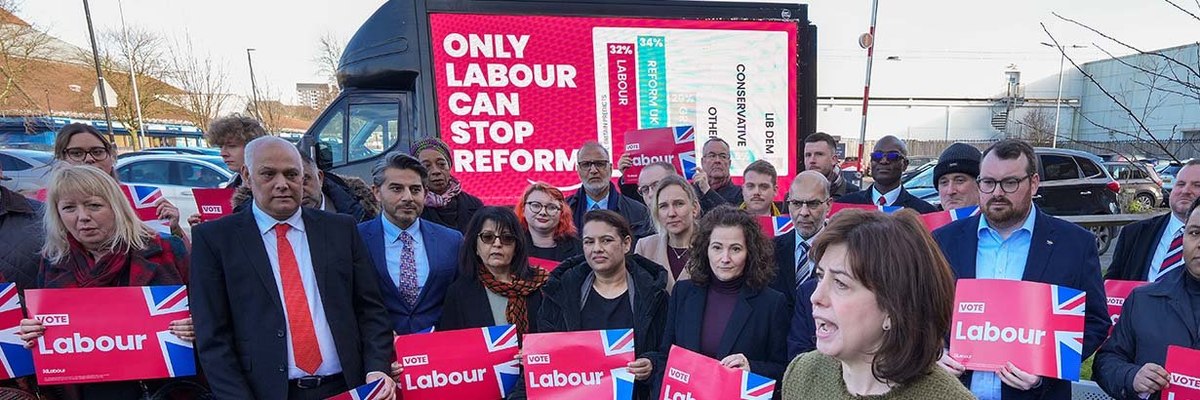
Significant numbers of Labour, Lib Dem and Green voters are prepared to vote tactically for each other, as well as the Conservatives, to stop Reform UK
Key takeaways
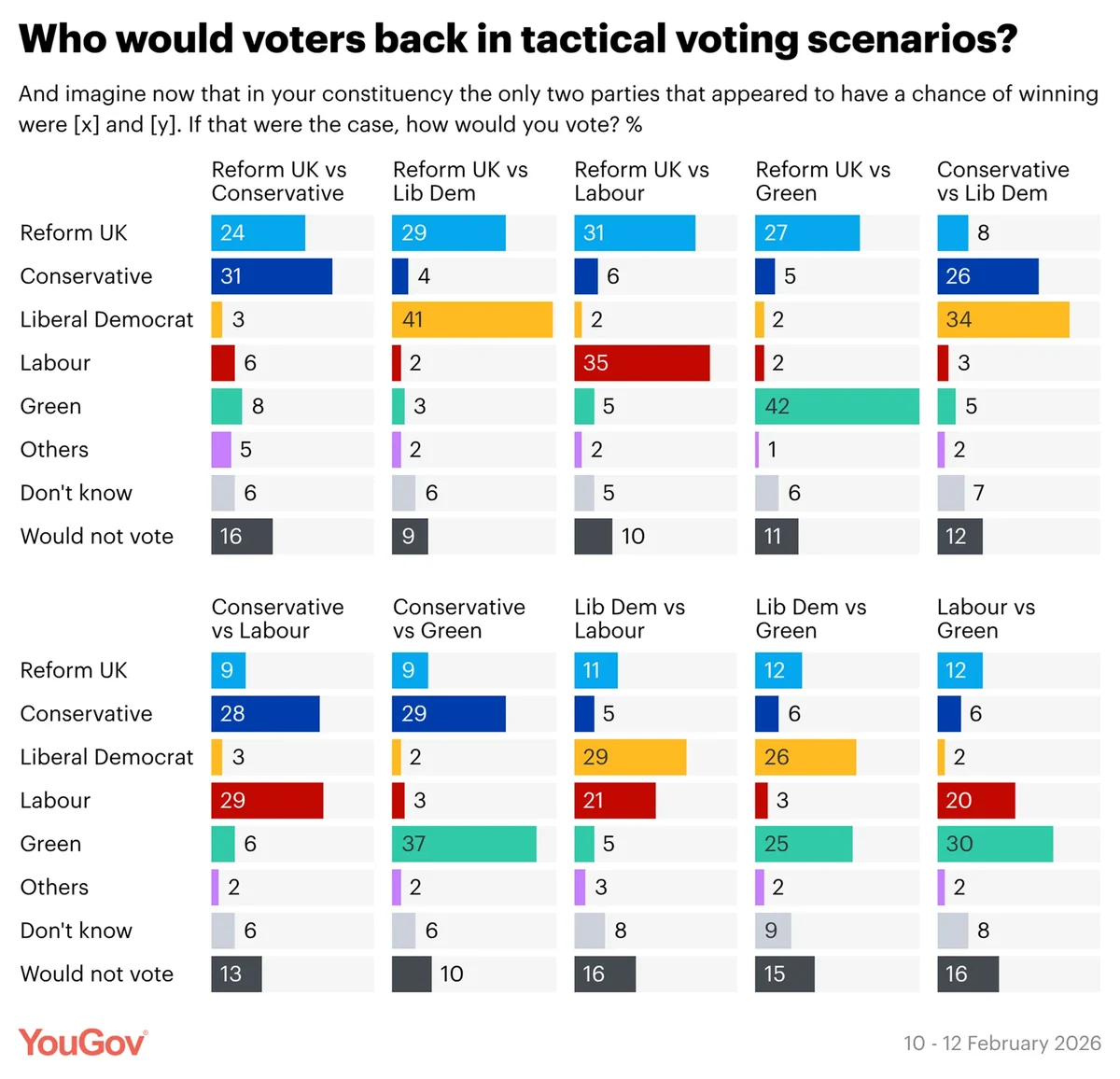
- In a constituency contest between Labour and Reform UK, voters would back Keir Starmer’s party by 35% to 31%
- 57-58% of Lib Dem and Green voters would tactically vote for Labour to stop Reform UK winning in their seat, though just 43-44% would do so to stop the Tories
- 63-77% of Labour voters would tactically vote Lib Dem or Green to prevent the Conservatives or Reform UK winning in their seat
- If only the Conservatives or Reform UK stood a chance of winning in their seat, voters would favour the Tories by 31% to 24%
- 43-45% of current Reform UK voters would vote Tory if their seat was between the Conservatives and Labour, the Lib Dems or Greens
- Voters are split 29% to 28% in a contest where only the Conservatives or Labour could realistically win in their constituency
Tactical voting – i.e. voting for a party other than your first choice in an attempt to stop a more disliked party from winning – has become commonplace in British politics. Such voter behaviour is credited with delivering Labour and the Lib Dems many more seats than they would have otherwise won at the 2024 general election.
It has even become a core part of parties’ electoral strategies, with Downing Street believing that fear of Reform UK winning will alone be enough to pressure Lib Dem and Green voters into backing Labour at a future election.
But with voting patterns in recent by-elections suggesting tactical voting is now taking place on ‘both sides’ of British politics, a new YouGov voting intention study examines which voters are willing to use their ballots tactically and who it could benefit.
Who would Labour voters back in tactical voting scenarios?
Labour voters are some of the most enthusiastic tactical voters. In the five of our tactical voting scenarios that involved the Lib Dems or Greens, but not Labour, appearing to have a chance of winning in their constituency, just 15-21% of those currently backing Labour say they would stick with the party.
Around three quarters (76-77%) would instead switch to either the Lib Dems or Greens to try to stop Reform UK winning their seat, while 63-69% would tactically vote Lib Dem or Green in two-way contests between them and the Conservatives.
Few Labour voters would back a right-wing party in any situation, though 30% would be willing to back the Tories if only the Conservatives or Reform UK appeared to have a chance of winning their seat. This is against 35% who say they would stick with Labour and 17% who would abstain.
Who would Green voters back in tactical voting scenarios?
Green voters are a little less willing to vote tactically, with at least 35% of current supporters sticking with the party in all but one of our tactical voting scenarios.
Nonetheless, 57% of current Green supporters would tactically vote for Keir Starmer’s party in a fight between Labour and Reform UK, though this rate falls to clearly less than half (44%) in a constituency fought largely between Labour and the Tories.
Instead, Greens’ greater enthusiasm is for the Lib Dems, with 67% saying they would tactically back the party against Reform UK and 57% against the Conservatives.
Who would Lib Dem voters back in tactical voting scenarios?
A similar pattern is evident among current Lib Dem voters. While nearly six in ten (58%) would back Labour in a contest between them and Reform UK, just 43% would do so in a seat fought between Labour and the Tories, with 19% instead backing Kemi Badenoch’s party.
Nearly three quarters of Lib Dems (73%) would switch to the Greens if they were the only realistic challenger in a seat to Reform UK, with 60% doing so in constituency contested mainly between the Greens and the Tories.
Where Reform UK and the Conservatives were the only parties seemingly in with a chance of winning, nearly half of Lib Dems (45%) say they would vote Conservative to keep Farage’s party at bay.
Who would Reform UK voters back in tactical voting scenarios?
Tactical voting among supporters of right-wing parties is both less common and less mutual, though it is still present.
In contests between the Conservatives and either Labour, the Lib Dems or the Greens, current Reform UK supporters are roughly divided between the 37-41% who would remain with Reform and the 43-45% who would instead switch to backing the Tories.
Few Reform UK supporters are willing to tactically back ‘progressive parties’ in any scenario, with one in six current Reform UK supporters (17-18%) inclined to instead not vote if only two such parties were capable of winning in their constituency.
Who would Conservative voters back in tactical voting scenarios?
Around four in ten current Conservative supporters (37-41%) are prepared to vote tactically to keep left-wing parties from winning in their seat, backing Reform UK in two-way contests between Farage’s party and either Labour or the Lib Dems. A further 32% are willing to do so if the battle were between Reform UK and the Greens.
But current Conservatives are more open than their Reform-voting counterparts to backing ‘progressive parties’. Indeed, in a seat where only the Lib Dems and Reform UK could win, a quarter (24%) would tactically vote for the Lib Dems, neutralising the impact of many of those tactically voting for Reform UK.
The Lib Dems would also be the beneficiaries of Tory tactical votes in Labour versus Lib Dem contests, with current Conservatives split in such seats between the 36% who would stick with their party and the 35% who would back Ed Davey’s party instead.
Who would voters back in a contest between Reform UK and Labour?
In YouGov’s MRP last September, Labour and Reform UK were the two largest parties in nearly 300 seats, many decided on small margins where tactical voting could make all the difference.
Among all voters, faced with the prospect of a Labour versus Reform battle, the former lead the latter by a four point margin of 35% to 31%, a significant contrast to Reform UK’s consistent leads in our regular voting intention question.
Although not a decisive lead for Labour, ultimately Lib Dem and Green voters are more willing to loan their ballot to Labour than Conservatives are to Reform UK.
What is apparent throughout our scenarios, but particularly when it comes to Labour versus Reform UK, is how much British voting behaviour now resembles two fragmented ‘voting blocs’. This is particularly clear when looking at the composition of the vote shares in this tactical voting scenario.
The 35% tactical share for Labour is largely comprised of those currently intending to vote Labour (13 points), Green (7pts) or Lib Dem (6pts), as well as those backing others such as the SNP (2pts). A further 6pts comes from those who said they were unsure or were unlikely to vote in our normal voting intention question. A mere single point comes from Conservative voters on the ‘other side’.
Likewise, just two points of Reform UK’s 31% tactical vote share comes from those ordinarily supporting parties from the opposing ‘bloc’, with 20 points coming from current Reform UK voters, six from current Conservatives and four from those otherwise unsure or unlikely to vote.
Who would voters back in a contest between Reform UK and the Conservatives?
In a shift from our previous tactical voting study a year ago, the Conservatives now lead Reform UK by seven points (31% vs 24%) in a scenario where they are the only two parties who can realistically win in a seat, having previously been effectively tied 26% to 25%.
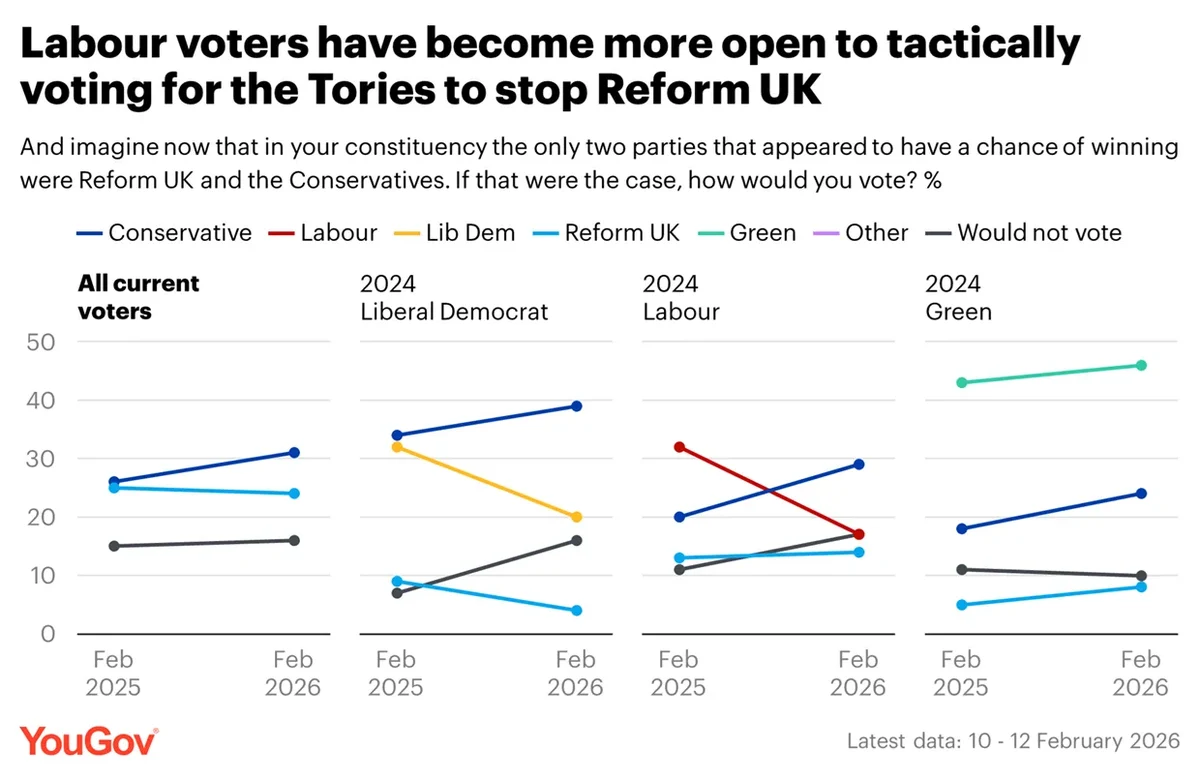
This comes from greater proportions of Labour, Lib Dem and Green voters being willing to back the Tories in opposition to Reform UK. For instance, 2024 Labour voters are now more likely to say they would back the Tories than stick with Labour (29% vs 17%), having previously broken in the opposite direction by the same margin (20% vs 32%).
Who would voters back in a contest between Labour and the Greens?
Even in YouGov’s MRP last September, which was conducted prior to the Greens’ recent polling surge, Labour and the Greens were projected to be the two largest parties in 46 seats, the most common ‘top-two’ combination not involving Reform UK.
If voters imagine these are the only two parties who could win in their seat, the Greens hold a healthy 10 point lead over Labour (30% vs 20%), with current Conservative, Lib Dem and Reform UK voters all favouring green over red.
Not all the switching in these scenarios may be tactical, however, with one in eight current Labour voters (13%) saying they would instead back the Greens in these circumstances.
Who would voters back in a contest between the Conservatives and Labour?
Traditionally, most seats were contests between the Conservatives and Labour. While such seats would be few and far between on current polling, in this tactical voting scenario, they are on a knife-edge, with 29% saying they’d back Keir Starmer’s party and 28% opting for Kemi Badenoch’s official opposition.
Relative to the Labour versus Reform UK match-up, greater reluctance among Lib Dem and Green voters to back the government prevents Labour from holding a lead over their opponents.
Who would voters back in a contest between the Conservatives and the Lib Dems?
As was true in many seats the Lib Dems won in 2024, the party’s ability to win tactical votes from supporters of the other ‘progressive parties’ allows Ed Davey’s party to maintain a convincing eight point lead over the Conservatives (34% vs 26%), in scenarios where they are the only two parties that appear to have a chance of winning.
Who would voters back in other tactical voting scenarios?
Although contests between Reform UK and the Lib Dems or Greens have been rare so far, the latter pair could prove the most able to defeat Nigel Farage’s party through tactical voting. In scenarios where they were the only realistic contender to Reform, voters would back the Greens by a substantial margin of 42% to 27%, while similarly favouring the Lib Dems over Reform UK by 41% to 29%.
The Greens also lead the Conservatives by 37% to 29% in their tactical match-up, with the public favouring the Lib Dems over Labour by 29% to 21% if they were the only two options with a realistic chance of winning in their seat.
Were the Lib Dems and Greens going head-to-head against each other, voters end up split 26% to 25%.
Interested in taking YouGov surveys? Would you vote tactically in your first-choice party couldn’t win in your constituency? What do you think about voting in general, and everyone else? Have your say, join the YouGov panel, and get paid to share your thoughts. Sign up here.
Interested in commissioning YouGov research? We connect in real-time with real people around the world to gather their thoughts, behaviours, and opinions, to ensure that our research data is powered by reality. Explore our survey services here.
Photo: Getty