
How often do Britons let the tears flow? What is likely to make Britons cry? Is it acceptable to cry at work?
- Women are more than twice as likely as men to say they have cried in the last month (71% vs 30%)
- 27% of men say the last time they cried was longer than a year ago
- Out of 16 upsetting scenarios polled, at least half of women say they would likely cry in 14 of them, relative to most men saying they would likely cry in just three of them
- 51% of Britons say it is acceptable to cry at work
- Women are split 43% to 49% over whether or not they would feel able to comfort a crying stranger, with just 26% of men feeling able to do so
While crying might be a perfectly ordinary expression of sadness, and something practically all of us have done, it can still carry stigmas. A new YouGov poll reveals all about where, when and why Britons let the tears flow, and when they think the traditional British stiff-upper lip should prevail.
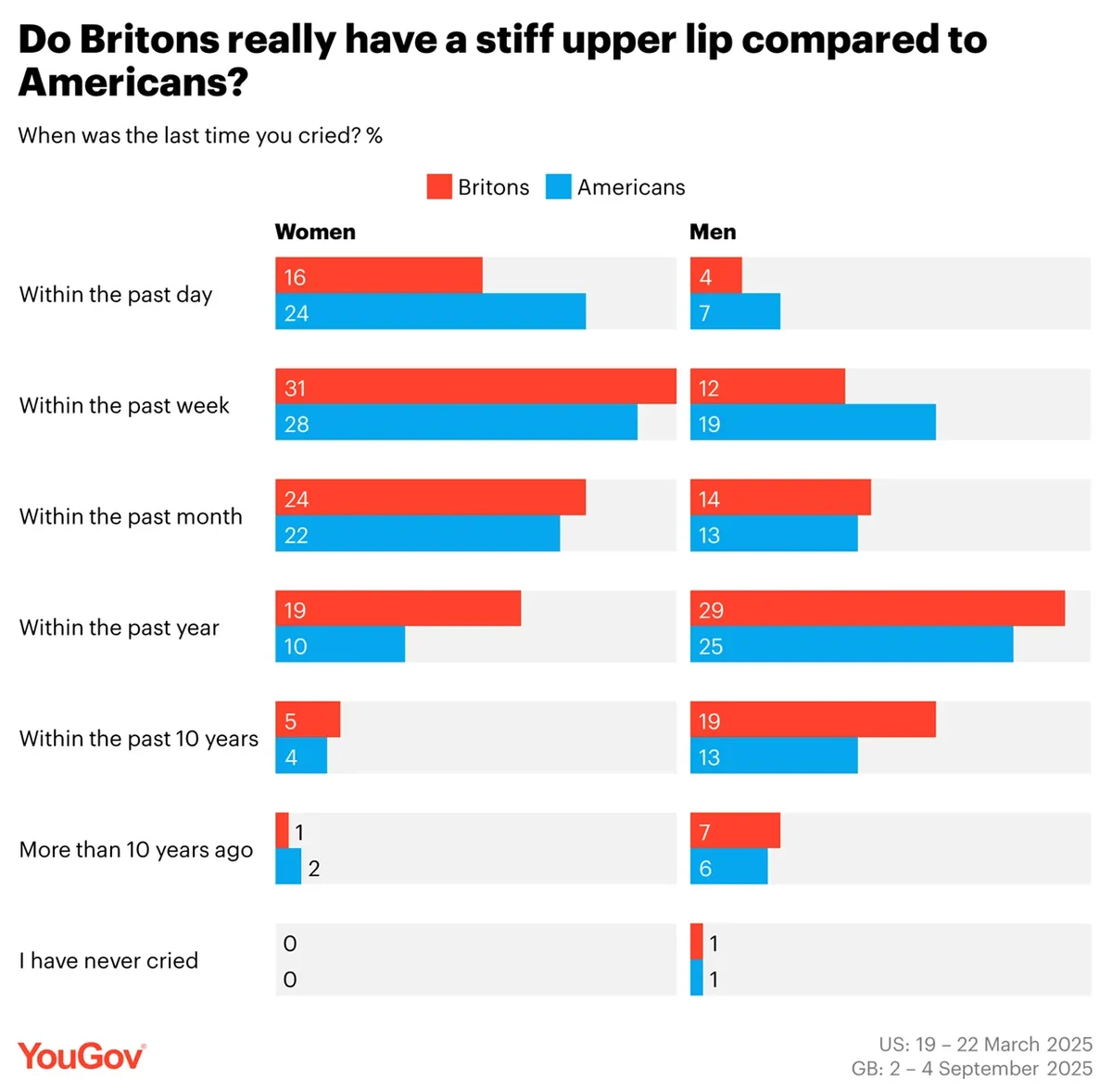
Half of Britons (50%) say they had cried in the month leading up to our survey, including roughly a third (31%) who had cried in the past week. But this masks a substantial gender divide, with 71% of women saying they had cried in the past month, more than double the 30% of men who said the same.
By contrast, nearly as many men (27%) say it had been more than a year since they last cried, something true of just 6% of women.
Among women, there is a generational divide, with 84% of 18-24 year old women saying they had cried in the past month, compared to 58% of over 65 women, the same as the proportion of 18-24 year old women who had cried in the past week alone.
By contrast, 25-32% of men in all age groups say they had cried in the preceding month, although older men are more likely to say they have not cried within the last year, with 40% of over 65 men doing so, compared to 17% of 18-24 year old men.
The stereotype of Britons having a stiffer upper lip has sometimes been contrasted with the more emotional Americans.
American men are indeed more likely to have recently wept, with four in ten (39%) having cried in the preceding month, compared to three in ten of their British counterparts. Additionally, just 20% of American men say it had been more than a year since they shed their last tear, relative to 27% of British men.
There is less difference among women, with 71-74% in both countries having cried in the past month, though British women are less likely to report having cried in the past day (16% vs 24%).
What is likely to make Britons cry?
Across 16 upsetting situations polled, men are consistently less likely than women to say they would probably cry, with most men saying they would likely let the tears flow in just three of the scenarios: the death of a loved one (84% say it is at least somewhat likely they would cry), the death of a pet (61%) and chopping onions (55%).
This compares to at least half of women saying they would be likely to cry in 14 of the 16 situations, from nearly all (96%) saying they would do so at the death of a loved one, through to 51% when seeing someone else cry or while reading a sad book. The two exceptions among our scenarios are listening to sad music and feeling extremely happy, though 34-39% of women say they would be at least somewhat likely to cry in those situations.
Over the 16 scenarios, women are on average 27 percentage points more likely to say they would likely cry than men, with the greatest difference being when arguing with a partner or family member: 61% of women say they would probably cry in such a situation, compared to just 22% of men.
Despite older Britons typically being a bit more stoical than their younger counterparts, in most cases, likelihood of crying in these situations does not vary significantly between generations.
One of the biggest exceptions is when feeling extremely sad, with 75% of 18-24 year olds and 68% of 24-49 year olds saying they would be likely to cry in such a situation, compared to 60% of 50-64 year olds and 57% of over 65s. Similarly, nearly half of under 50 age groups (48-49%) say they would be likely to cry while arguing with a partner or family member, compared to 33-37% of over 50 age groups.
The youngest age group are also more likely to say they would cry when in physical pain, with 57% of 18-24 year olds saying they would do so, relative to 41-44% of other age groups.
By contrast, younger Britons are less likely to saying they would probably cry when seeing something bad happen to someone else, with just 38% of 18-24 year olds doing so, compared to 47% of 25-49 year olds, 49% of 50-64 year olds and 53% of over 65s.
Britons' slightly stiffer upper lips are again apparent here, being less likely than Americans to say they would cry in eight of the twelve scenarios polled on both sides of the Atlantic. For instance, just 26% of Britons say they would be likely to cry when feeling extremely happy, compared to 37% of Americans.
Britons are also less likely than Americans to say they would cry when in physical pain (44% vs 52%), when feeling extremely sad (64% vs 71%) and when seeing someone else cry (37% vs 44%).
However, Britons and Americans are roughly equally likely to cry when experienced the death of a loved one (89-90%), the death of a pet (73-76%), while chopping onions (63-64%), and when arguing with a loved one (40-42%).
Do Britons think it is acceptable to cry in public?
One of the bigger divides around crying is not necessarily why people are doing it, but where and when. For instance, chancellor Rachel Reeves’ tears in the House of Commons last year sparked conversations about whether it was okay to cry at work.
Half of Britons (51%) say it’s at least usually acceptable to cry while at work, relative to 40% who believe it’s typically unacceptable. The established gender divide around crying isn’t particularly present here, with 53% of women and 47% of men both believing it’s generally okay to weep at work.
A larger seven in ten Britons (70%), including 75% of women and 67% of men, believe it’s usually or always acceptable for somebody to cry when in a public place, compared to 20% who feel it’s unacceptable to be publicly in tears.
Did Britons see their parents cry growing up?
While 78% of Britons say they saw their mother cry during their childhood, including 41% who saw her weep more than a few times, just 37% recall ever seeing their father cry while they were growing up, including a mere 5% who remember it happening more than once or twice.
There is, though, a clear generational shift. Half of 18-24 year olds (51%) say they saw their father cry at least once while they were growing up, roughly double the 26% of over 65s who recall their father tearing up.
Do Britons feel able to comfort someone crying?
Around nine in ten women (89-90%) and nearly eight in ten men (75-79%) say they would feel at least fairly able to console a friend or family member who was crying.
Seven in ten women (70%) also feel able to comfort an upset colleague, a skill that divides men, with 49% feeling at least fairly able to rise to such an occasion, relative to 42% who have little or no confidence in their ability to do so.
Feeling able to comfort a crying stranger is less common, with women divided 43% to 49% over whether they would be able to do so, alongside just 26% of men.
This is a case of age seemingly building experience, with older Britons more likely to say they would feel able to console someone who they saw crying.
For instance, nearly two thirds of those in the over 50 age groups (64-65%) say they would feel at least fairly able to comfort a tearful colleague, compared to just 58% of 25-49 year olds and less than half of 18-24 year olds (46%).
Interested in taking YouGov surveys? When do you think it’s acceptable to cry? What do you think about expressing your emotions in general, and everything else? Have your say, join the YouGov panel, and get paid to share your thoughts. Sign up here.
Interested in commissioning YouGov research? We connect in real-time with real people around the world to gather their thoughts, behaviours, and opinions, to ensure that our research data is powered by reality. Explore our survey services here.
Photo: Getty