
While people in the six largest European countries prioritise European autonomy over the US-Europe alliance, they are unwilling to take the steps needed to build Europe up as a rival power
Key takeaways
- Survey conducted in Britain, France, Germany, Italy, Poland and Spain
- Attitudes towards the USA again hit a new low
- 34-61% see the US as a major or moderate threat to Europe
- Europeans don’t think Europe is strong enough to stand up to the US in the event of a major quarrel; fewer than half think it ever could be
- Europeans favour autonomy over preserving the US-Europe alliance…
- …but are unwilling to do the things necessary to build up Europe as a rival power base, like increasing military spending, adopting a more hard-nosed foreign policy, or reducing trade with the US
- Support for NATO remains high
- Europeans tend to think the continent can ride out Donald Trump’s presidency, and don’t except him to leave NATO or end the US-Europe alliance
The end of this week sees senior politicians, diplomats, military and security gather in Germany for the Munich Security Conference.
Last year, US vice president JD Vance stunned European onlookers by saying that illegal immigration was the most urgent challenge faced by Europe, criticising their commitment to free speech and democratic fundamentals, and repeated Donald Trump’s complaints that Europe relies too much on the US for defence.
The remarks called into question America’s commitment to the US-Europe alliance, and one year on recent events regarding Greenland make that question more pertinent than ever.
European attitudes towards the US are increasingly negative
If the Trump administration were to push the issue, the tendency in Europe is to prioritise preserving European policy independence and values over maintaining the Europe-US alliance. In the UK in we saw a shift towards the former over the course of the Greenland crisis, whereas opinions have remained largely static on the continent.
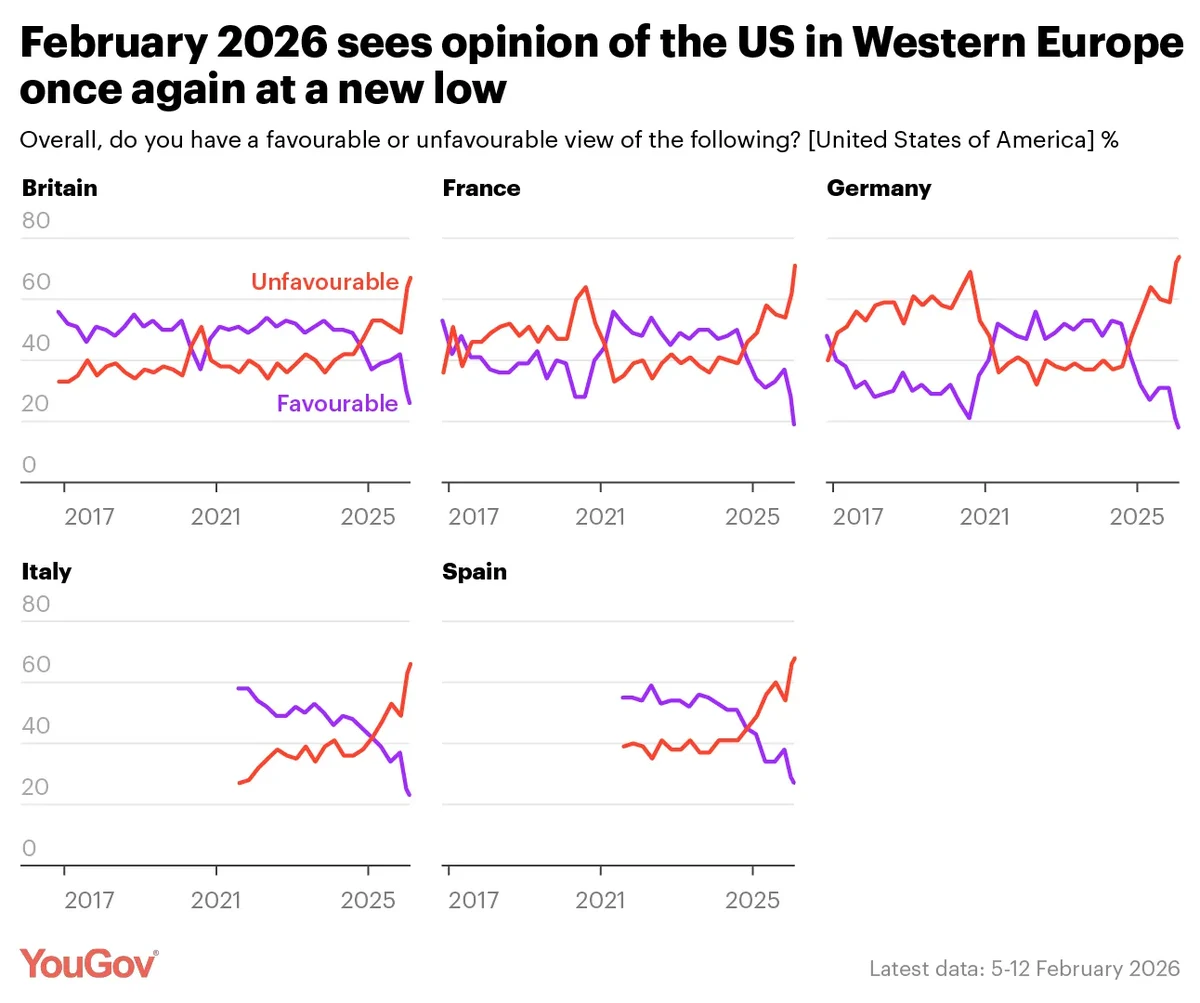
Favourability towards the US in Europe continues to plumb new depths, with this month’s survey seeing the most negative attitudes recorded since we began tracking in 2016 – although in most cases this represents only a marginal movement since January.
The exception is France, where there has been a full nine-point drop in favourable attitudes towards the US over the last month.
Between 11-31% now consider the US to be a major threat to Europe, rising to 34-61% if you include those who see it as a moderate threat, figures broadly comparable to – and in some cases higher than – the perceived threat from China, Iran or North Korea, although still far behind Russia.
Indeed, between 17% and 28% of Europeans picked US foreign policy as one of their top three threats facing Europe – a figure which in each case had increased since September – meaning the issue ranked 2nd-6th overall in each nation.
While Europeans may feel increasingly unhappy with – and threatened by – the US, they nevertheless seem to feel the continent is powerless against its Atlantic ally.
Most Europeans feel that peace and prosperity on the continent are currently reliant on good relations with the US, and tend to think that America is stronger than Europe militarily, economically, and diplomatically.
In the event of a major quarrel, just (14-26%) think that European countries collectively are currently powerful enough to stand up to the US.
Indeed, many are sceptical that Europe has even the potential to rival US might, if the continent made sufficient changes. Fewer than half in any country (27-44%) think that even if Europe got its act together it could stand up to the US.
So if Europe feels threatened by the US, is willing to go it alone, and aware of its power deficit, is the continent willing to do what it takes to build itself up as an independent power base?
The answer is no.
Only 12-40% in each country surveyed believe that the EU is spending too little on its armed forces, and there is likewise unwillingness across the continent to put more money into armed forces if it meant tax increases, spending cuts or increased borrowing.
Likewise, Europeans aren’t prepared to reduce reliance on trade with the USA if it meant an increase in the cost of living, nor are they prepared to abandon a foreign policy focus on democracy and human rights in favour of national self-interest.
While Europeans tend to support a European army, backing for such a force has not risen in connection with recent US foreign policy (although it did rise following the Russian invasion of Ukraine in 2022).
And in any case, there is division on allowing defence and security decisions to be made at the EU rather than national levels – most Spaniards are enthusiastic while most Poles are opposed, with the French, Germans, and Italians relatively split.
Instead Europeans seem contented with current NATO defence arrangements. Most in each country say they support NATO membership, and think it is important to their national defence.
Some countries are much more reticent about paying more for NATO, however, without only 27-30% of French and Italian people willing to do so (in contrast to 50-55% of Germans, Britons and Poles).
More broadly, while previous YouGov research showed that Europeans are ostensibly in favour of greater integration in a world where the US is hostile to Europe, few seem to believe that scenario is emerging, given our separate integration support tracker shows no change in attitudes since the Greenland crisis.
Europeans tend to think we can ride out Donald Trump, and tend to think he won’t end the US-Europe alliance
Part of this apparent complacency may be the expectation that America’s more abrasive foreign policy towards Europe is an aberration and will not outlast Donald Trump. This is the prevailing view in all countries surveyed except Germany, where people are more likely to think there has been a permanent shift in the American approach to the old world.
Likewise, few Europeans think with something close to certainty that Donald Trump will take dramatic actions towards Europe during his second term of office.
For instance, only 4-7% think Trump is "very likely" to end the diplomatic alliance and friendship with Europe and adopt a hostile foreign policy towards the continent.
It is the minority view that under Trump the US has a high likelihood of withdrawing from NATO (5-11%), or removing its forces from the continent (4-8%).
And similarly there are limited expectations that under Trump the USA would be very likely to use military force against other countries in Europe (2-8%); 4-8% think he is likely to seize Canada, and 9-15% to grab Greenland.
Europeans are most likely to think Trump would engage in a trade war against Europe, although this still amounts to only 9-23% who think there is a high chance this will happen.
As to whether America is on the path to a dictatorship, few Europeans again believe this has a high likelihood of coming to pass (9-18%).
Interested in taking YouGov surveys? What do you think about Europe's place in the world, how we should engage with the USA, and everything else? Have your say, join the YouGov panel, and get paid to share your thoughts. Sign up here.
Interested in commissioning YouGov research? We connect in real-time with real people around the world to gather their thoughts, behaviours, and opinions, to ensure that our research data is powered by reality. Explore our survey services here.
Photo: Getty