
Europeans are now more negative towards the US, and prefer to prioritise European autonomy over preserving the transatlantic alliance, but are they willing to make sacrifices in order to do so?
While Donald Trump now appears to have accepted a largely symbolic territorial concession from Greenland, the recent spat over a potential American military operation to seize the island has thrown into stark relief Europe’s inability to stop the US president from doing something if he sets his mind to it.
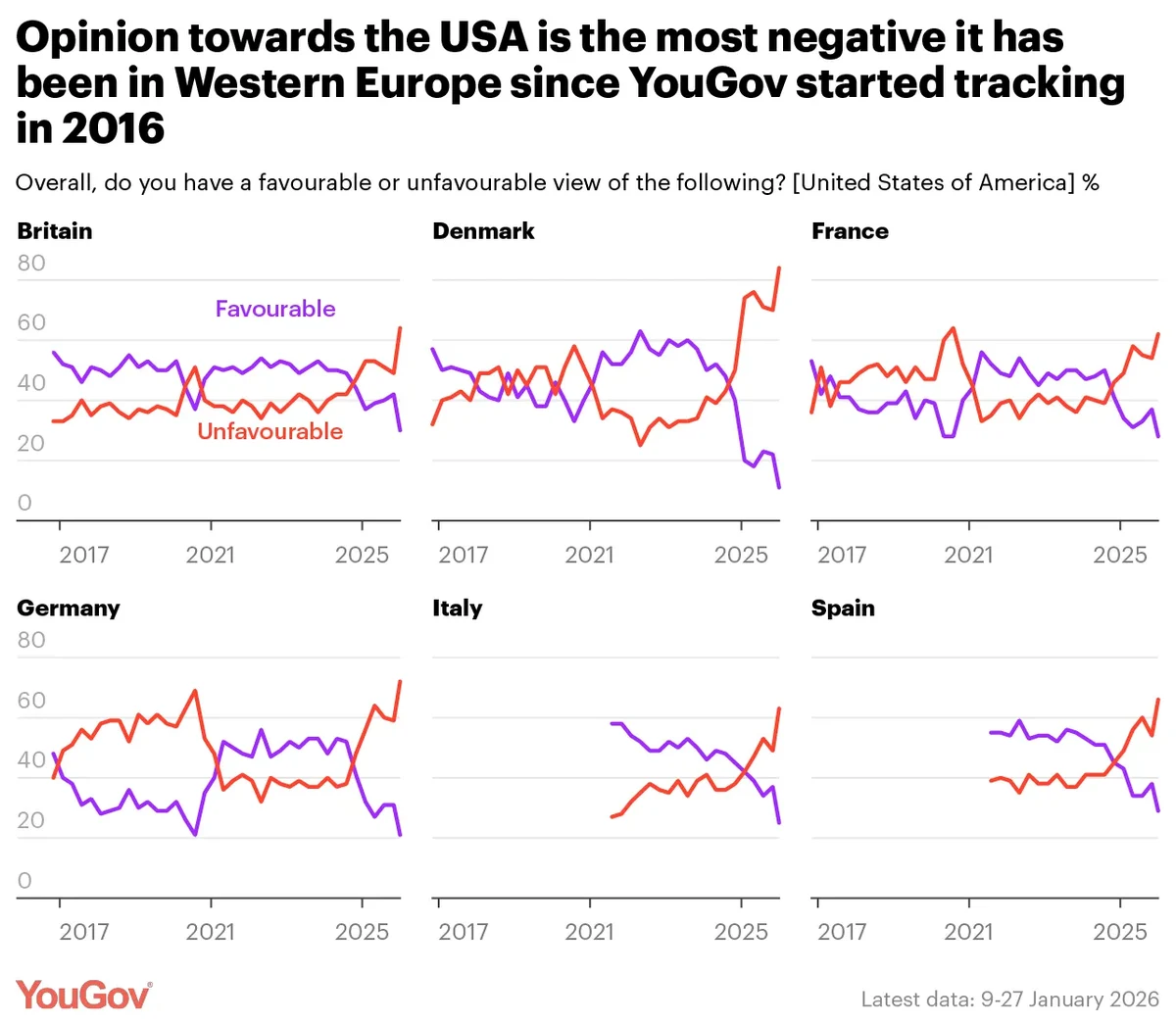
New YouGov European tracker data, conducted in Britain, Denmark, France, Germany, Italy and Spain between 9-27 January, shows that perceptions of the USA have become even more negative as a result of the Greenland crisis – in five of these countries they are now the worst they have been since we started tracking in 2016.
Unsurprisingly, opinion is most negative in Denmark, of which Greenland is an autonomous territory. Fully 84% of Danes now have an unfavourable view of the USA, up from 70% in November 2025 (and compared to an average of 36% over Joe Biden’s term as president).
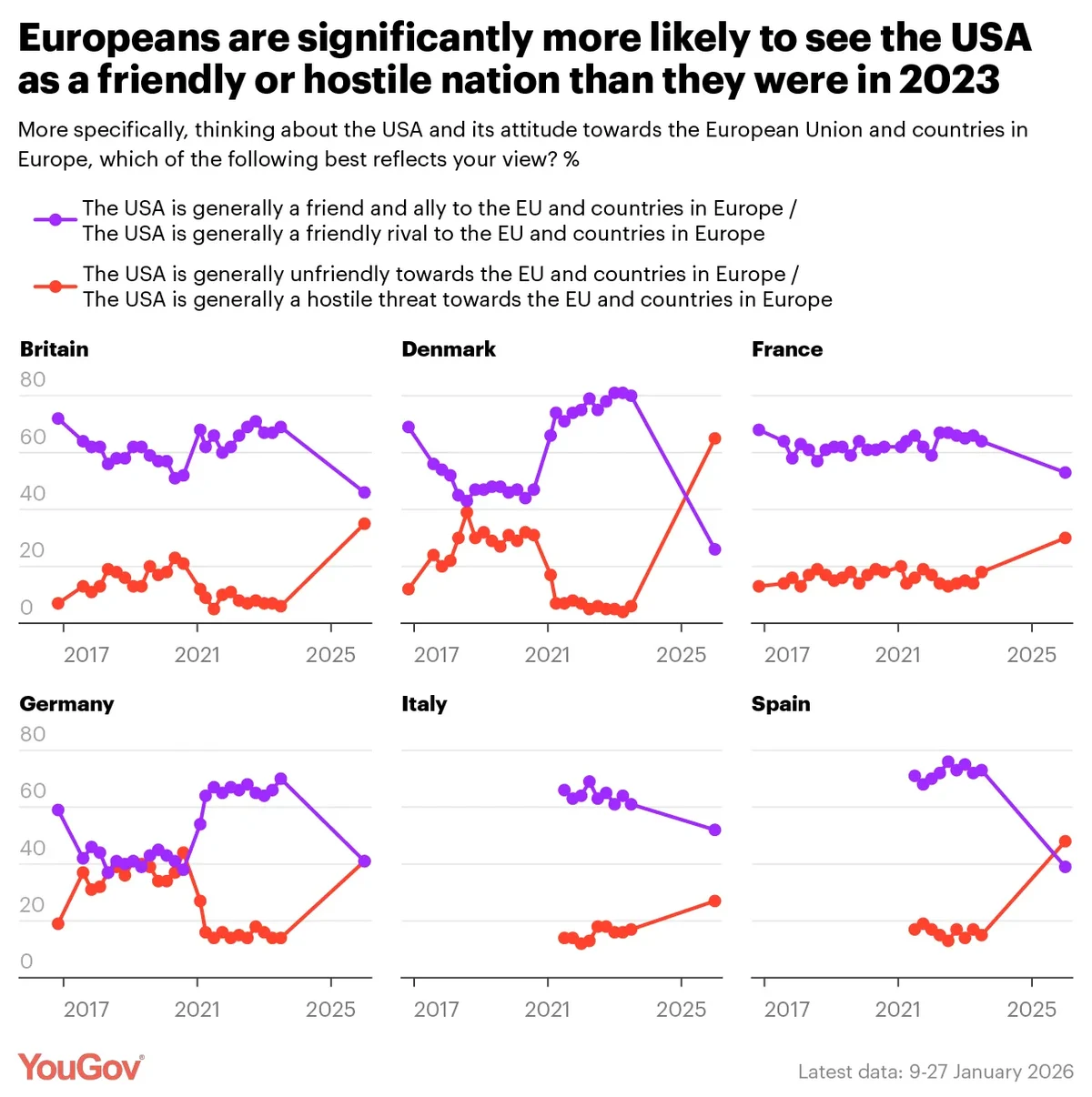
Not only is the US now seen more negatively, but Europeans are increasingly of the belief that it is no longer a friendly nation, with the number seeing America as either a friend and ally, or at least a friendly rival, having fallen significantly since we last asked in 2023.
Nowhere is this more clear than in Denmark, with only 26% of Danes seeing the US as an ally or friendly nation, compared to fully 80% in July 2023.
Fewer than half in Spain (39%), Germany (41%) and Britain (46%) continue to see America as friendly or an ally, with slightly more than half saying the same in Italy (52%) and France (53%).
Likewise, Western European attitudes towards Donald Trump himself remain resolutely negative.
While Trump and his attitudes towards Europe might be unpopular, that is not to say that Europeans completely disagree with his assessment of the continent.
Europeans tend to agree with the Trump administration’s assessment that Europe has been too reliant on the US for defence (59-74%), has allowed too much immigration (52-63%) and that it is indecisive and unwilling to act on the world stage (45-62%).
However, far fewer agree that the continent is too restrictive when it comes to free speech (18-31%), and fewer still echo Trump’s claim that Europe has been unfair in its trade dealings with the USA (10-17%).
How do Europeans see Europe in relation to the USA?
While there was speculation that Europe might have powerful means of economic retaliation against the USA had the country gone further against Denmark, the results of our survey show that most Europeans see the USA as being stronger than Europe in economic terms (as well as diplomatically and militarily).
Denmark is the exception – while 75% believe the US has a stronger military than Europe, only 34% think they are a stronger economy and 32% think they are more powerful diplomatically.
If Europe does seek to extricate itself from American dominance, it will have to contend with the security vacuum that will leave. Europeans are alive to this issue – between 63-78% in the countries surveyed believe European peace and defence are reliant upon the USA.
At least half (49-64%) likewise think that economic prosperity on the continent is reliant upon good relations with our transatlantic cousins.
It is no surprise, therefore, that Europeans tend to believe that a breakdown between Europe and the USA would have a negative impact on Europe’s ability to defend itself, peace and stability on the continent, and on the economies of their own country and of Europe more widely.
That said, the plurality view in Britain, Denmark, Italy and Spain (43-48%) is that such a seismic ruction would make little difference to their own household finances – French people and Germans by contrast are about evenly split between those who think it would have little impact (38-39%) and those who think it would have a negative effect (36% in both countries).
Where do Europeans stand on trying to preserve relations with the US versus standing up for Europe?
The Greenland crisis shows that Europe ultimately faces two choices: to embrace a subordinate role to the USA in the Western alliance, or to more assertively establish its own autonomy in the world.
In almost all countries, the preference is to preserve European autonomy over the transatlantic alliance. Perhaps unsurprisingly, Danes are the most likely to feel this way, at 55%.
(This question was subsequently asked again in the UK only, a week after fieldwork for this project, finding the preference for European autonomy had increased to 53% and the US-Europe alliance figure had reduced to 23%).
France is the outlier, with their public split between 41% who want to prioritise preserving European policy independence and values versus 39% who say it is more important to preserve Europe’s alliance with the USA.
Having said they want to prioritise European autonomy, an early litmus test for European publics is how they thought the continent should have reacted had the USA seized Greenland.
Danes are the most likely to want to have seen retaliation against the USA, either military (16%) or economic (47%). Britons too are slightly more likely to come down on the retaliation side of the fence (44%) than to want to only pursue a diplomatic approach (33%) or just accept US control over Greenland (5%).
Elsewhere, however, Europeans tend to prefer the “monitoring the situation” approach to crisis management. Around half of Italians (50%), Germans (47%), Spaniards (47%) and French people (47%) would opt either to take a diplomatic approach or otherwise acquiesce to US ownership of Greenland.
So if Europe is reliant upon the US’s good graces for peace, stability and prosperity, what are Europeans – and particularly those who prioritise preserving the alliance – willing to do in order to keep relations warm?
The only thing that Europeans in all countries would be willing to do to keep the US on side is reduce immigration – hardly a big commitment, given they already think immigration has been too high.
People in Britain, Denmark, France and Germany would likewise be prepared to increase national military spending in order to placate the US, although Spaniards and especially Italians are not prepared to do so.
And only Danes and Britons are net willing to greatly increase contributions to the Ukraine war effort.
For all the other examples given, Europeans are overall unwilling to countenance action to please the USA. This includes: loosening restrictions against hate speech; adopting a trade policy towards other countries along lines preferred by the US; agreeing trade deals that are slightly/substantially more favourable to the US than Europe; covering the cost of US armed forces in Europe; agreeing US-requested trade policies that would slightly raise the cost of living; and disbanding the EU.
Even among those who prioritise the transatlantic alliance over European autonomy, there is still limited willingness to take actions that would improve relations with the Trump administration, with only a small number of examples (primarily in Spain) where this group are net willing to do something that the overall national public is not.
One factor that may be in play is the expectation among many Europeans that if we just ‘ride out’ Donald Trump then US foreign policy towards the continent would return to how it was previously.
This theory is particularly common in Denmark (57%), although 46-51% in Britain, France, Italy and Spain agree – only 22-27% think that US foreign policy towards Europe has now changed permanently.
Germans are outliers, being split, with 39% expecting a return to ‘normality’ after Trump’s departure, but 41% thinking America’s stance towards the continent will not revert.
Whether the transatlantic alliance survives may not be within Europe’s control in any case, if the US president is determined to turn his back on the continent. So what do Europeans think we should do if the alliance broke down and relations became hostile?
Most Europeans believe that a breakdown in the relationship between the US and Europe would necessitate greater spending on domestic armed forces, except in Italy, where only 32% think more should be spent on the military if the transatlantic alliance turned hostile.
There is division on whether to step up support to Ukraine if American animosity towards the continent resulted in their withdrawing support – while Danes, Britons and to a lesser extent Spaniards, are willing to pick up the slack, Germans, French people, and especially Italians are not.
And few in any country (20-31%) are willing to countenance a more hard-nosed foreign policy that would attempt to forge closer relations with other major powers, even if this meant overlooking human rights issues.
By contrast, there is net support for embarking on greater political integration, with more powers and decision-making happening at the EU level, should the US-Europe alliance break down.
Between 46% and 63% support this approach – in all cases outweighing those opposed by a significant margin.
However, the results of a previous question in this survey suggest that attitudes towards integration have ultimately not been stirred by the Greenland crisis. Asked earlier in the same survey as part of our standard questions, a significantly lower 24-52% said they wanted a closer union between EU countries. In each case, this figure is effectively the same as in the previous wave, back in October.
That is to say, that while Europeans ostensibly are willing to support greater integration in the hypothetical event that US-Europe relations sour, the lack of movement on this tracker question suggest that the events of the last month seem to have done nothing to convince them that such an outcome is currently in the process of taking place.
Separately, we again see that there is limited difference between those who prioritise European autonomy and the wider public in willingness to make changes to compensate for a world in which the US and Europe are no longer allies – indeed, this group appear generally less likely to want to adopt a foreign policy that seeks engagement with other major powers.
Interested in taking YouGov surveys? What do you think about the Greenland crisis, Europe's relationship with the USA, and everything else? Have your say, join the YouGov panel, and get paid to share your thoughts. Sign up here.
Interested in commissioning YouGov research? We connect in real-time with real people around the world to gather their thoughts, behaviours, and opinions, to ensure that our research data is powered by reality. Explore our survey services here.
Photo: Getty