

Four in ten say it is “very important” to strengthen the UK’s ‘hard power’, but are they willing to do so if this meant tax rises or public services cuts?
Key takeaways
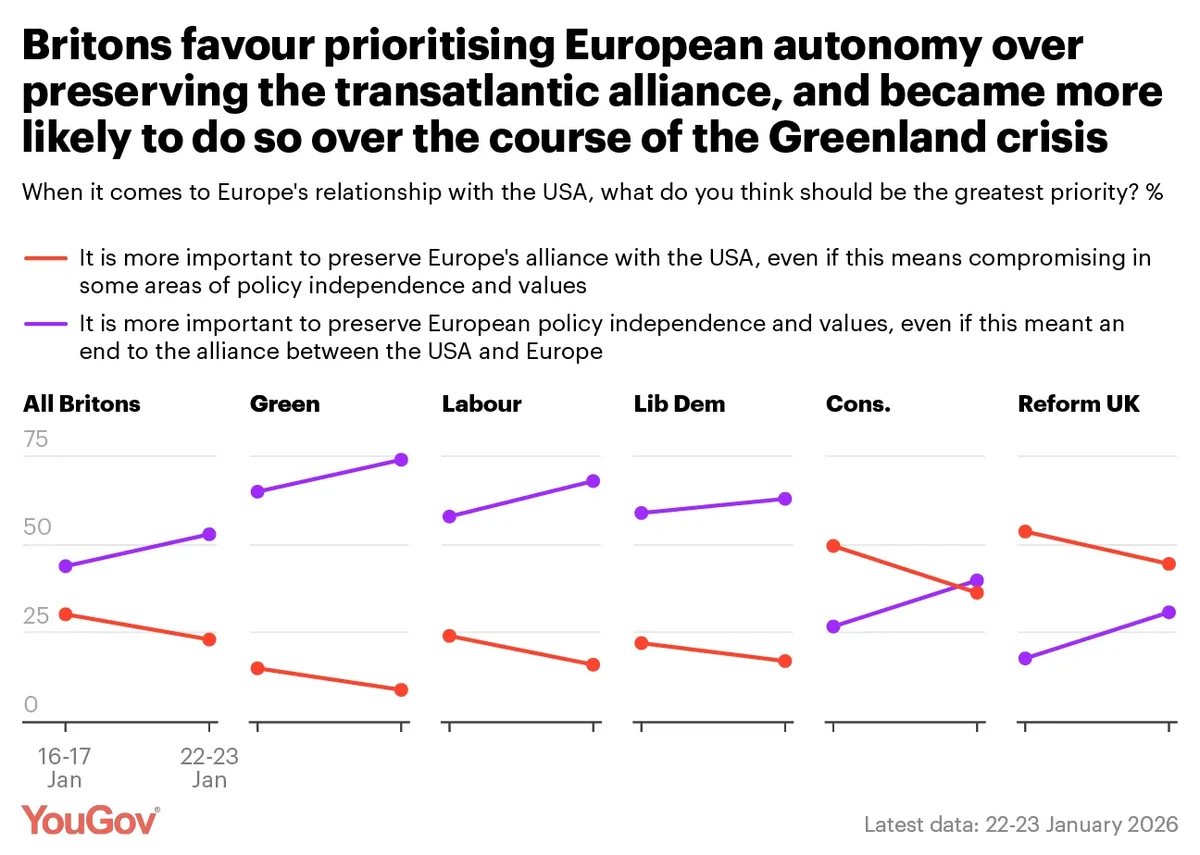
- Britons increasingly say European independence and values more important than preserving alliance with USA
- Four in ten consider it "very important" to increase UK hard power and soft power - although voting groups differ greatly on their relative importance
- Only a minority favour tax increases or spending cuts to fund greater spending on the armed forces - including those who say it is very important to increase UK hard power
- Likewise, few support a more self-interested UK foreign policy that does not try to promote human rights abroad, including those seeking to bolster European independence from USA
- Greenland crisis does not appear to have affected public attitudes on rejoining EU
While Donald Trump now appears to have accepted a largely symbolic territorial concession from Greenland, the recent spat over a potential American military operation to seize the European nation has thrown into stark relief Europe’s inability to stop the US president from doing something if he sets his mind to it.
Following the row, the British public are increasingly sure that they would prefer that European countries (including the UK) adopt a foreign policy approach that prioritising European autonomy and values (53%) over the preserving the transatlantic alliance (23%).
This represents a nine point increase in the more pro-Europe view since mid-January, when the dispute was in full flow, and a seven point reduction in the more pro-US view.
Britons say the UK needs to become more powerful – but are they willing to pay for it?
The number of Britons who told us that “defence” is a top national issue rose ticked up to 25-26% at the height of the Greenland crisis, according to our tracker data.
The results of this poll show that three quarters of Britons consider it important to strengthen the UK’s hard power (military and security capabilities) and soft power (diplomacy and international prestige), including around four in ten who consider it “very important” that we do so.
Notably, voters are at odds over the relative importance of these two measures. While 61% of Reform UK voters and 57% of Tories say increasing Britain’s hard power is “very important”, this falls to just 25% and 31% respectively when it comes to soft power.
Likewise, while half of Green voters (49%) think it is very important to boost the UK’s soft power, this compares to only 13% who say the same of hard power. Labour and Lib Dem voters too are about as likely as the Greens to see soft power as very important (48-50%), but are more convinced of the urgency of improving our hard power as well (38-41%).
However, few Britons actually appear willing to countenance the steps necessary to boost British power in an increasingly hostile world.
Only a quarter (25%) are willing to see taxes rise in order to better fund the armed forces; a similar number (24%) say the same of making cuts to public spending. Funding greater defence spending through more borrowing is more popular, although still only 34% are willing to back such an option.
Again, a third (37%) are willing to reintroduce conscription, although unsurprisingly the generations are divided on this: only 16% of 18-24 year olds are supportive, compared to 57% of the over-65s.
Just one in three (33%) would countenance a more hard-nosed foreign policy based solely on UK self-interest, that did not attempt to promote democracy and human rights abroad.
And only three in ten (30%) would be willing to see the cost of living increase in order to reduce reliance on trade with the USA.
Looking at how those who prioritise European autonomy over preserving the US-Europe alliance answered showed that this group too are more unwilling than willing to back any of the measures asked about.
Among those who say it is “very important” that Britain boosts its hard power, there is more willingness than not to borrow more for the armed forces, conscript young people, and adopt a more self-interested foreign policy – but still overall opposition to measures that would increase taxes or the cost of living, or require cuts to public services.
Have recent events made Britons more willing to rejoin the EU?
“The post-1945 global order is being replaced by one in which ‘might makes right’, time to rejoin the EU so we can assert ourselves as part of a bloc,” is how the FT’s Stephen Bush summarised the view of Labour and Lib Dem MPs in response to the Greenland crisis.
Certainly, few Britons (12%) think that the UK is currently powerful enough to stand up to the USA in the event of a serious quarrel – and only 18% think it ever could be.
However, fully 63% think that European countries collectively do currently have the power to stand up to the USA.
So are Britons now more amenable to rejoining the EU? YouGov polling has consistently shown that the majority of Britons support the UK returning to the EU, and this poll is no different.
The recent spat with the USA appears to have made no difference to public sentiment in this regard – in early January 55% of Britons backed a return to the European Union, and on 22-23 January this figure stood effectively unchanged at 54%.
Prompting people on what they would want in the event that the alliance between the USA and Europe (including the UK) broke down and relations became hostile found only a small uptick in support for rejoining, to 59%.
This small increase at the topline reversed when asked about rejoining an EU that was no more unified, with more powers being given to the body than at present, including on defence policy and with a unified European army. Under this scenario, 54% of Britons again say they would be willing to rejoin the EU.
While this is perhaps a surprisingly small change between the two scenarios, it should be noted that there is a much more notable impact under the surface, with 41% “strongly supporting” rejoining in the event of a breakdown in relations with the US, but only 25% doing so if the EU was more integrated. (Under the standard question ‘strong’ support is 36%).
Interested in taking YouGov surveys? What do you think about Britain's place in the world, how to pay for growing our national power, and everything else? Have your say, join the YouGov panel, and get paid to share your thoughts. Sign up here.
Interested in commissioning YouGov research? We connect in real-time with real people around the world to gather their thoughts, behaviours, and opinions, to ensure that our research data is powered by reality. Explore our survey services here.
Photo: Getty