
Key takeaways
- YouGov experiment found the British public overall were not less likely to support two popular policies when Keir Starmer’s name was attached to them
- They were, however, somewhat less likely to do so if told Nigel Farage reportedly backed them
- Some shifts in opinion are observed within specific voting groups, most notably that Nigel Farage’s name reduces support for otherwise popular policies among those intending to back non-Reform parties
Following the initial announcement of the government’s digital ID card scheme – which has since been watered down – long-standing support for the concept of introducing national ID cards reversed. This led some commentators to describe Keir Starmer as having a “reverse Midas touch”, whereby everything he touches turns to, well, not gold.
But is that really the case? A new YouGov polling experiment tests whether attaching politicians’ names to a policy impacts its support among the wider public. Respondents were asked about two popular policies to see whether being linked to Keir Starmer or Nigel Farage boosts or sinks this support.
How does support for a policy change when Keir Starmer and Nigel Farage’s names are attached to it?
When asked whether they support or oppose spending more money on housing for veterans without attaching the proposal to a specific politician, seven in ten Britons (69%) say they support the idea, while only 15% oppose.
A different group of respondents were told that Keir Starmer reportedly believes in the policy; this did not substantially change support (70%) or opposition (14%) towards the idea.
By comparison, the group who were told that Nigel Farage reportedly believes in the policy were less likely to back it, with support dropping nine points compared to the control framing, to 60%, while opposition rose by eight points to 23%.
A separate survey asked a similar question on the premise of increasing funding for animal welfare. In this scenario, there was less change between the different groups, with Farage seeing a six point drop in support compared to the control wording, from 60% to 54%, while Starmer’s change is sufficiently small as to be within the margin of error.
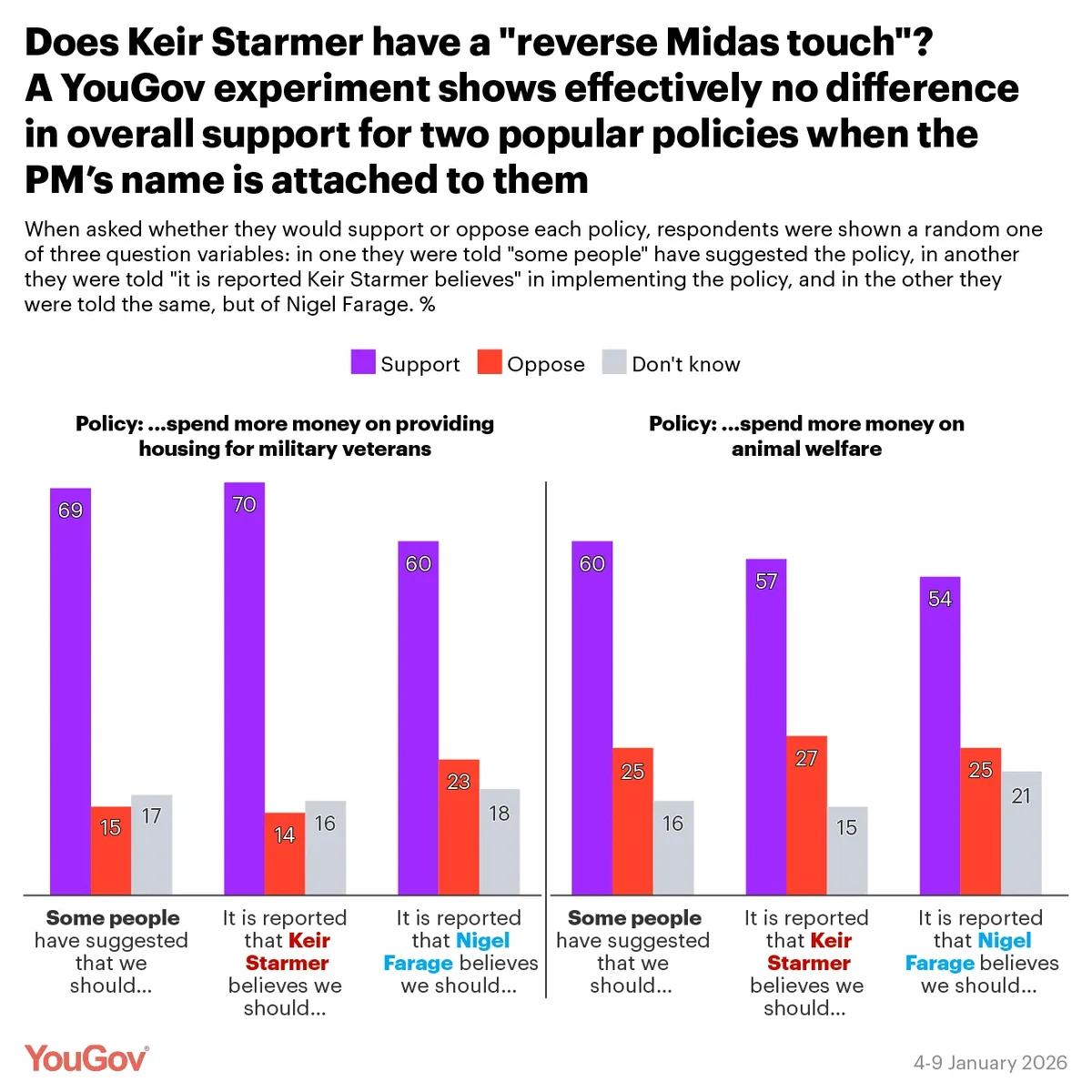
How far do voters change their minds on a policy when the Labour or Reform leaders’ names are attached to it?
For both policies tested, support and opposition at the topline did not significantly change for Starmer; however, the underlying composition did change.
When asked about spending on veterans, support among current Labour voters jumped from 63% in the control wording to 72% when told Starmer believes in the policy; likewise, there was a similar boost among Liberal Democrats. This effect was less present when asked about animal welfare spending, though there was a drop in support among current Reform voters for the policy.
Linking Farage to the policies saw large shifts in voters’ support. When asked about greater veterans spending, Reform voters became slightly more likely to back the policy when told Farage did likewise, while support among voters for all other major parties fell substantially, with the most notable being a 19 point drop in support among current Labour voters.
We see similar results for the animal welfare question, with the largest shift coming from current Green voters, who see a 19 point drop in support for spending more on animal welfare when the policy is linked to Farage, from 79% to 60%.
Do they have the “reverse Midas touch”?
These findings are not in and of themselves enough to conclude that Starmer or Farage do not have a “reverse Midas touch”. However, they do suggest that being linked to the policies can influence some voters’ opinion along partisan lines, resulting in a situation where policies are judged for who backs them, rather than their merits and drawbacks.
See the full results here and here
Interested in taking YouGov surveys? What do you think about Keir Starmer and Nigel Farage, British politics in general, and everything else? Have your say, join the YouGov panel, and get paid to share your thoughts. Sign up here.
Interested in commissioning YouGov research? We connect in real-time with real people around the world to gather their thoughts, behaviours, and opinions, to ensure that our research data is powered by reality. Explore our survey services here.
Photo: Getty