

There are significant differences in attitudes towards ‘illegal’ and ‘legal’ migrants
Key takeaways
- New YouGov research looks at attitudes in France, Germany, Italy, Spain, Denmark and Poland
- In the major Western European nations surveyed, there is a tendency to believe that there are more illegal than legal migrants staying in their country
- Approximately half in each country surveyed (45-53%) support a scenario where not only are no new migrants permitted, but large numbers of recent migrants are required to leave
- Deportation proponents in Europe broadly want to see ‘rule-breaking’ migrants removed, rather than all migrants
- The study posed trade-offs, asking respondents to pick between reducing legal migration and its potential adverse consequences, or the more economically beneficial alternative, but at the cost of higher legal migration
- In almost all cases Europeans are less likely to choose to reduce immigration and accept its downsides over the alternative trade-off
Immigration has been a significant issue in Europe in recent years. At this year’s federal elections in Germany it easily topped the list of issues that voters were concerned about. In the UK likewise, immigration frequently tops YouGov’s most important issues tracker; the Conservatives’ failure to tackle the issue in government has led to their being supplanted on the right of British politics by Reform UK.
So where do European publics stand on the issue of immigration? A new YouGov European survey conducted in France, Germany, Italy, Spain, Denmark*, Poland*, and the UK* finds support for reducing immigration is high – as ostensibly is the desire to see large numbers of migrants removed.
* Only portions of the overall study were conducted in Denmark and Poland. The UK data is drawn from an equivalent study from May-June
But a recent YouGov UK version of this same survey found that these sentiments are potentially influenced by a mistaken belief that far more immigration to the UK is legal than illegal. Does the same trend hold true in Europe?
Western Europeans tend to believe most migrants in their country are staying illegally
In the major Western European nations surveyed, there is a tendency to believe that there are more illegal than legal migrants staying in their country, from a low of 44% in Germany who think so to a high of 60% in Italy.
In Poland – the only non-Western European nation surveyed – the public are much more divided: 36% also believe there are more illegal than legal migrants in Poland, compared to 28% who think the opposite is true, and 22% who think the relative numbers are about the same.
These perceptions look likely to be wide of the mark, with estimates of illegal migrant numbers in each country substantially lower than official figures for the foreign-born portion of the population in each case. For example, in France the interior minister Laurent Nunez recently revealed government estimates that there are 700,000 illegal migrants living in the country, far below the more than nine million foreign-born people legally resident in France.
As with the UK, it is possible that these misconceptions about the legal vs illegal migration mix stand at the root of negativity towards the issue.
Europeans are opposed to greater levels of migration, and most support scenarios that see significant reductions in inflows
Across six migration scenarios we asked about, the results of our survey show that Europeans are overwhelmingly opposed to a large increase in the number of new migrants allowed to come to their country, and are divided (Denmark and Poland) to opposed (all others) on keeping immigration levels as they are.
By contrast, the most supported of the scenarios we asked about all involve either admitting no further migrants, or dramatically curtailing their numbers.
Indeed, approximately half in each country surveyed (45-53%) say they support a scenario where not only are no new migrants permitted, but large numbers of recent migrants are required to leave.
Deportation proponents in Europe broadly want to see ‘rule-breaking’ migrants removed, rather than all migrants
So does this widespread desire to see large-scale removals of foreigners represent a wholesale rejection of immigration across the continent, or are concerns more specific?
The results tend to suggest it may be more the latter. When we followed up with those saying they want to stop migration and send large numbers of people home, asking who exactly they had in mind, answers primarily focus on those coming to coming to claim benefits (78-91%) and other ‘rule-breaking’ migrants. This includes those entering Europe through irregular means to seek asylum (73-85%), and those coming without a valid work visa to work in unskilled jobs (66-85%).
There is more of a range when it comes to “people coming through another EU country to seek asylum in respondent country”, with the idea that asylum seekers are supposed to claim sanctuary in the first safe country they reach a common political argument, although actually a distortion of the EU’s Dublin Regulation.
Germans who support mass deportations are particularly likely to want to remove large numbers of this group, at 82%, but far fewer say so in Spain (49%), with the other EU countries surveyed sitting in between.
By contrast, appetite for the removal of other groups is limited, including for asylum seekers who follow the correct legal process, foreign students, workers on work visas in areas with skills shortages, skilled trades, or as doctors. This latter group are the one deportation backers are the least likely to say should be included, ranging from 15-24%. This is the equivalent of approximately 8-12% of the broader public in each country, which we could consider to be a rough ceiling for the most hardcore anti-migrant sentiment levels.
Likewise, a separate question more broadly examining positivity towards different migrant groups finds similar results, with negative views among mass-deportation proponents falling from 81-94% towards foreign welfare seekers to 19-43% for those seeking asylum through the correct legal process and to just 8-19% for foreign doctors.
Where do Europeans stand on reducing immigration versus economic trade-offs?
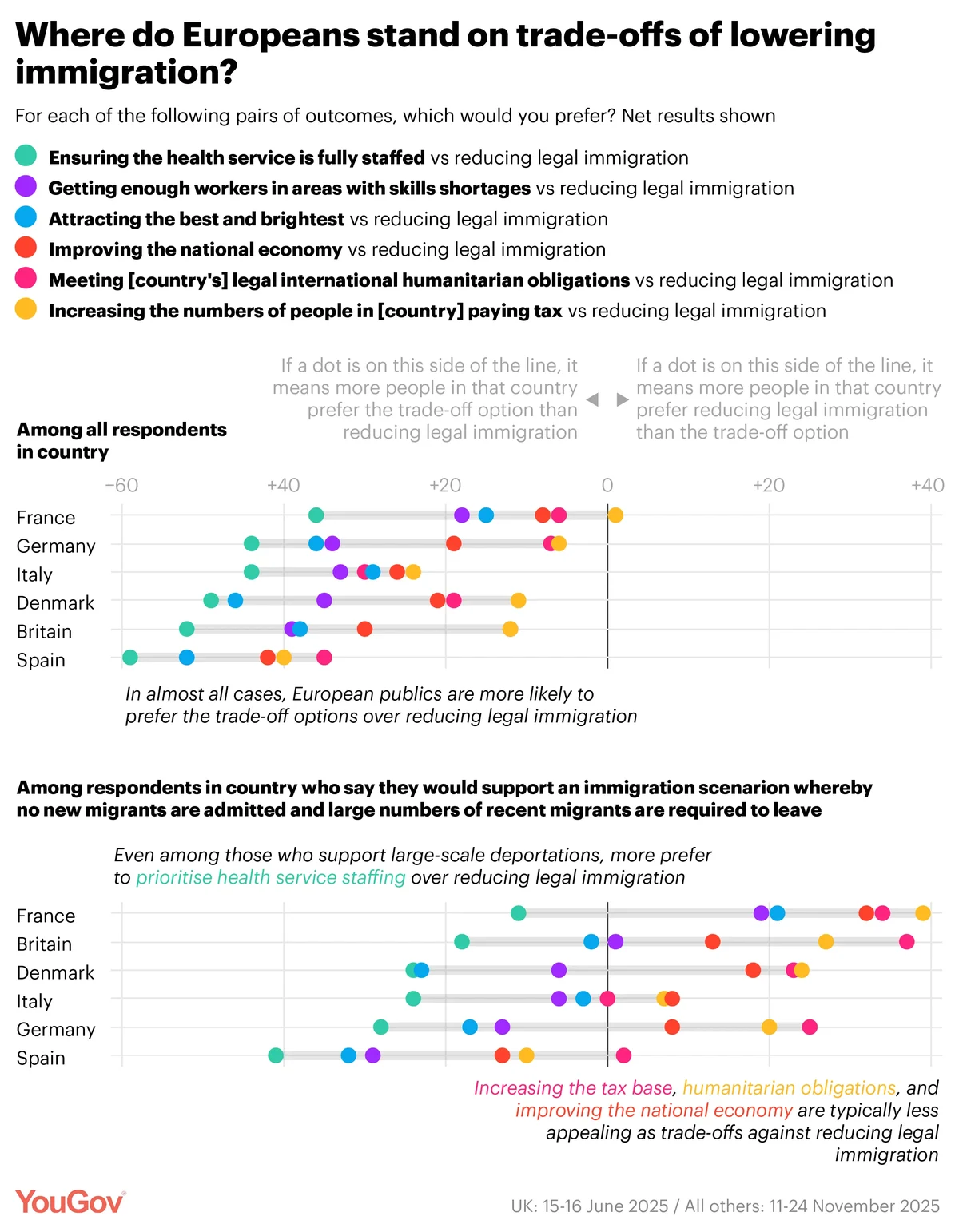
Removing immigrants would not happen in a vacuum, with many foreigners working in areas that countries have difficulty filling vacancies for, and our survey shows that lowering immigration does not trump economic considerations among European publics.
Our study posed trade-offs to Europeans, asking them to pick between reducing legal migration and its potential adverse consequences, or the more economically beneficial alternative, but at the cost of higher legal migration.
In each country, across the six economic and other trade-offs we asked about, in almost all cases Europeans are less likely to choose to reduce immigration and accept its downsides over the alternative trade-off.
Staffing levels in national health systems are consistently the greatest concern across the scenarios we asked about. Indeed, preserving healthcare appears to be the most convincing argument not to cut legal immigration among those who want to see large numbers of migrants deported: it is the only trade-off people holding this desire in each country tend to prioritise over reducing immigration.
The results likewise show that getting enough workers to fill skills shortages, as well as attracting the best and brightest, also tend to be relatively appealing arguments against reducing migration. By contrast, increasing the numbers of people paying tax is generally the weakest of the arguments, being consistently among the least likely to be chosen as a trade-off against reducing immigration, with maintaining legal international humanitarian obligations and improving the wider economy also tending to perform less well as arguments.
Europeans are divided on whether legal migration has been good for their countries
As we have seen, Europeans tend to think that there are more illegal than legal migrants living in their country, in contrast to actual estimates. This matters because people have far more negative opinions of illegal migrants and their contribution to their country than they do legal migrants.
For instance, while the majority in each country (56-75%) believe illegal migration to have been mostly bad for their country, opinion regarding legal migration is decidedly more mixed.
The most one-sided are the Spanish, with 42% seeing legal migration as having been mostly good for Spain, compared to 22% who think it has been mostly bad, and 26% who see the record as mixed.
French people and Germans are the most likely to see legal migration as having been mostly bad for their respective countries (38-39%), compared to 22-24% saying it has been good.
Nevertheless, while this study has shown that sentiment is clearly softer towards ‘legal’ migrant groups, the results do show that when the distinction between legal and illegal migration is made, many Europeans still think legal migration has been too high in their countries.
Across countries, the majority see the level of illegal immigration as having been too high (68-81%). Attitudes towards legal migration are more mixed: most French people (52%) and Germans (57%) believe levels have been too high, as do 48% of Poles and Britons. Spaniards and Italians are much more divided, with 42% in Spain saying too high but 36% about right, and an even closer 34%-30% ratio in Italy.
Legal migrants are perceived to not share national values
While our study has shown that Europeans’ attitudes towards immigration are potentially being influenced by overestimates of the numbers of illegal migrants, broader issues of cultural compatibility do also appear to be at play.
While few Europeans see illegal migrants as sharing the same values as native populations, and are not integrating successfully, there is a tendency to say the same of legal migrants as well.
Most in France, Italy and Germany (53-57%) say that legal migrants don’t share the same values as them, with 47% of Poles thinking likewise (far outnumbering the 25% who disagree). Spain is more divided, with 43% still feeling most legal migrants don’t share the same values, but 38% saying they do.
When it comes to integration, the French, Italians and Germans again are notably more likely to feel legal migrants are not being successfully integrated (49-57%) than to think they are (30-38%). Poles and Britons are closely divided, while Spaniards tend to come down more on the side of successful integration, by 48% to 42%.
As we noted in our UK study, while it is clear that legal migration dramatically outweighs illegal migration, that is not to say that if only Europeans could be made aware of this fact then immigration would disappear as an issue.
The concerns that many people have extend beyond the economic terms by which greater immigration is typically justified – anyone seeking to address the issue will need to engage with deeper anxieties about identity, integration, and the perceived erosion of shared national values.
Comparative national topline results are compiled across these two tables
Individual national demographic results tables are available below (please note, only portions of the study were run in Denmark and Poland)
Poland 1 (only)
Denmark 2 (only)
Great Britain results tables can be found here
Interested in taking YouGov surveys? What do you think about immigration levels to Europe, whether recent migrants should be required to leave, and everything else? Have your say, join the YouGov panel, and get paid to share your thoughts. Sign up here.
Interested in commissioning YouGov research? We connect in real-time with real people around the world to gather their thoughts, behaviours, and opinions, to ensure that our research data is powered by reality. Explore our survey services here.
Photo: Getty